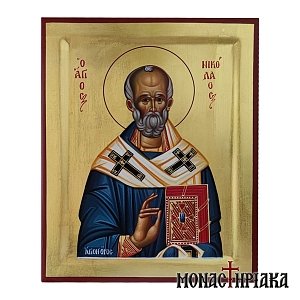
Hand painted icon of Saint Nicholas and Saint Barbara, made in Mount Athos, on natural wood. The icon is delivered in a wooden box.
Short life of Saint Nicholas and Saint Barbara
According to popular folk tradition, the festive three days of December 4, 5 and 6 are called "Nikolovarvara", as it includes the feasts of Saint Varvara, Saint Savvas and Saint Nikolas respectively. In fact, in the Peloponnese these days are often associated with death, due to the bad weather conditions that prevail.
Saint Nicholas was one of the most beloved saints of the Orthodox Church, whose reputation spread far beyond the region in which he lived. He was born in Patara of Lycia, in Asia Minor and was raised in a deeply Christian family. From a young age, he distinguished himself through his love and compassion for those suffering from poverty and hardship. After the death of his parents, he inherited a considerable fortune, which he did not keep for himself. Instead, he chose to distribute it to those in need, becoming widely known for his generosity and care for the poor. His virtue and spiritual life eventually led to his election as Archbishop of Myra. From this position, he served the Church with great zeal and dedication, though not without enduring trials. During the persecutions of Christians, he was imprisoned and suffered for his faith. Following the rise of Emperor Constantine the Great, he was released and returned to his pastoral duties, continuing to guide his flock with wisdom and love. According to sacred tradition, many miracles are attributed to Saint Nicholas, especially those connected with the sea. Because of these accounts, he came to be venerated as the protector of sailors and those who travel by sea. Saint Nicholas reposed peacefully in the fourth century and the Orthodox Church commemorates his memory on 6 December.
Saint Barbara is one of the best-known figures of the early Christian era. She lived in Nicomedia during the 3rd century and is remembered for her unwavering faith and courage in the face of persecution. According to tradition, she was the daughter of Dioscorus, a pagan who worshipped idols and sought to keep her away from Christian influences. Nevertheless, Barbara came to know Christ and secretly embraced the Christian faith. Her faith eventually became known when, during the construction of a bathhouse intended for her, she ordered a third window to be added in honor of the Holy Trinity. When her father learned of her Christian faith, he handed her over to the authorities. Despite the threats and brutal tortures she endured, Saint Barbara refused to renounce her faith. She was eventually sentenced to death, and according to tradition, it was her own father who carried out the execution. Saint Barbara is traditionally regarded as a protector against fire and lightning. She is also especially honored by artillerymen, miners, and those who work in mines and underground construction. The Orthodox Church commemorates Saint Barbara on December 4.