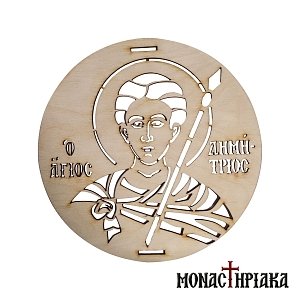
Small icon (lithograph) of Saints George and Demetrius on hard MDF with matte varnish.
Dimensions: 7 x 12 cm.
Brief life of Saint George and Saint Demetrius
Saint George was born around the end of the 3rd century in Cappadocia into a Christian family. From an early age, he experienced hardship, as his father died a martyr for his faith in Christ. After his death, his mother moved with him to Palestine. When he came of age, George joined the Roman army and quickly distinguished himself through his skill, bravery, and character. He rose to a high rank and gained great respect and recognition. However, when the persecutions against Christians began under Emperor Diocletian, George did not hesitate to confess his faith. He openly declared that he was a Christian and refused to worship the pagan gods. As a result, he was imprisoned and subjected to severe torture. Despite his suffering, he remained steadfast in his faith and never renounced Christ. According to tradition, God strengthened and supported him throughout his trials, enabling him to endure many miraculous torments. Eventually, he was beheaded, completing his martyrdom. In Christian tradition, Saint George is often depicted as a mounted soldier slaying a dragon, an image symbolizing the victory of good over evil and faith over fear and idolatry. Because of this, he became closely associated with the military and is considered the patron saint of the Infantry and the Army in general. The Church commemorates Saint George on April 23, but when this feast falls during Holy Week or before Easter, it is transferred to the first Monday after Easter.
Saint Demetrius is one of the most prominent figures of the Orthodox Church and the patron saint of Thessaloniki. He lived during the time of the Roman emperors and was born in Thessaloniki, where he stood out from a young age for his education, character, and military ability. Although he held a high rank in the Roman army, he chose to embrace Christianity and openly proclaimed his faith. During the persecutions of the Christians, he was imprisoned, where he became associated with Nestor, who was encouraged by the saint and went on to defeat Lyaios in single combat, a very strong and physically imposing gladiator. This act, however, provoked the emperor’s anger, leading to the execution of both Nestor and Demetrius. Saint Demetrius died in prison and was buried in Thessaloniki, where, according to tradition, myrrh flowed from his tomb, which is why he is called the Myrrh-streamer. After his death, tradition holds that Saint Demetrius continued to perform many miracles. Many believers regarded him as the protector of Thessaloniki, believing that he intervened to save the city from enemies, sieges and disasters. In times of crisis, according to tradition, he would appear as a mounted soldier and strengthen the inhabitants, giving them courage and hope. The Church commemorates Saint Demetrios on October 26.