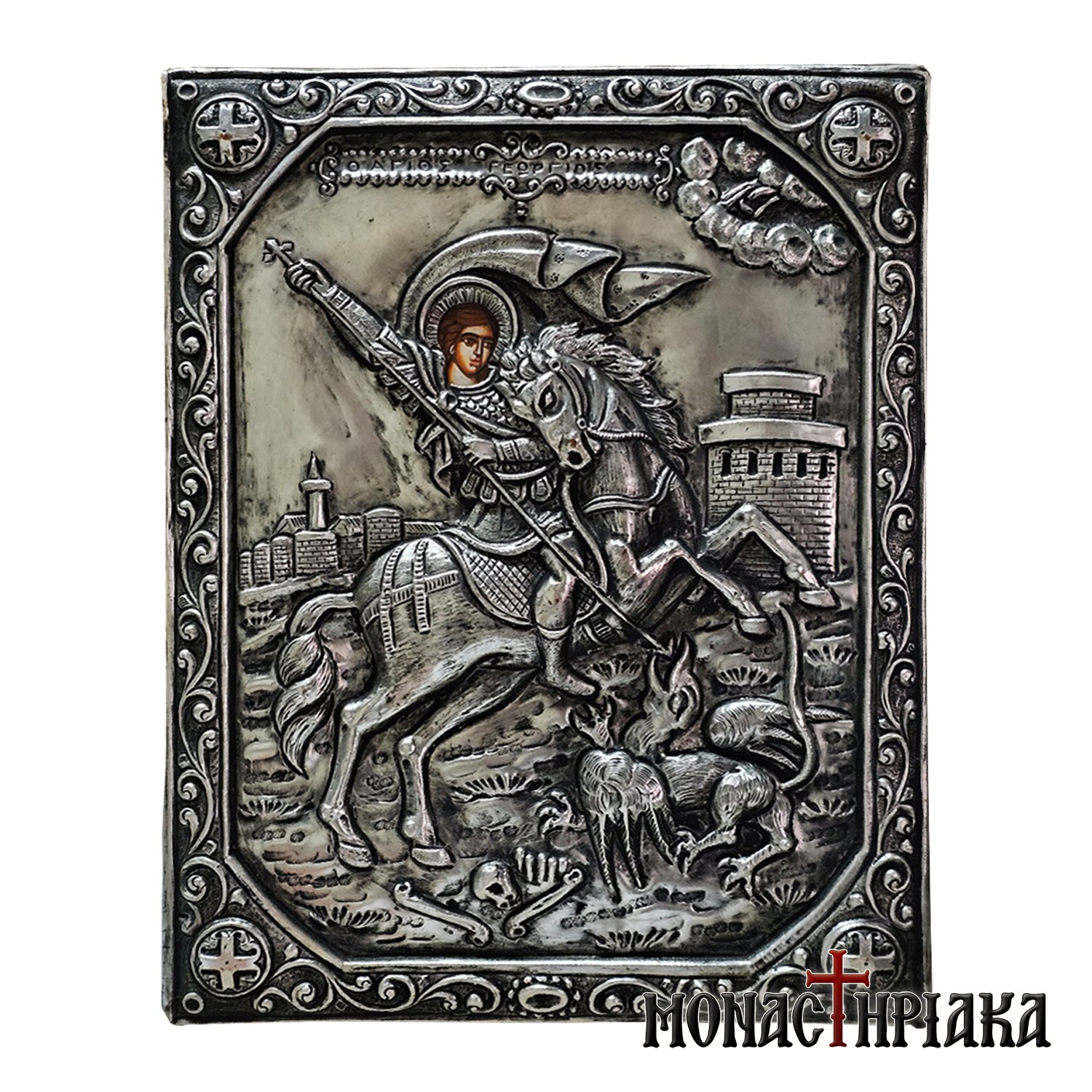
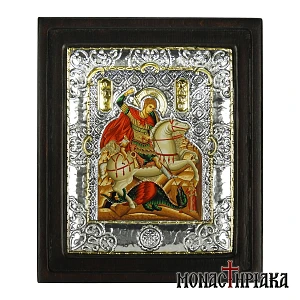
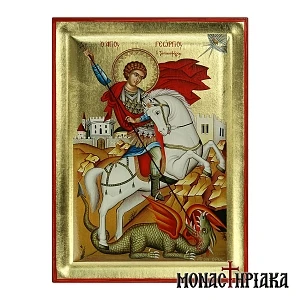
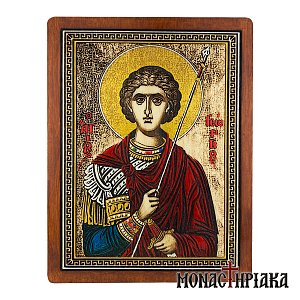
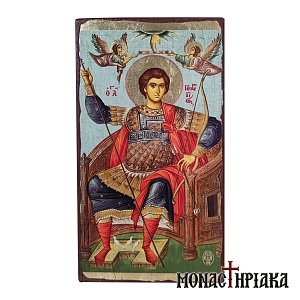
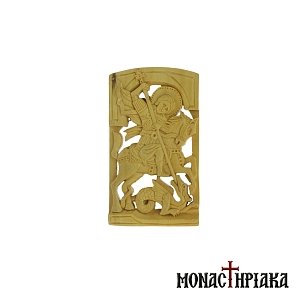
Silver icon with Saint George. Handmade silver icon on natural wood, made with 925ο silver. The natural wood used for the synthesis of the icon is beech (fagus) from Mount Athos, a wood that is receptive to aging techniques that give the appearance of vintage to the wood, without altering the depicted image.
The depictions of faces, hands, halos or other representations are hand-painted on canvas by specialized iconographers, according to the traditional techniques of Byzantine Iconography. The silver frame of the icon is held by nails to resemble the original icons. On the back side, the icon has a small metal ring made of horseshoe nails so that it can be hung.
Dimensions: 21 x 26 cm.
Brief life of Saint George
Saint George was born around the end of the 3rd century in Cappadocia into a Christian family. From an early age, he experienced hardship, as his father died a martyr for his faith in Christ. After his death, his mother moved with him to Palestine. When he came of age, George joined the Roman army and quickly distinguished himself through his skill, bravery, and character. He rose to a high rank and gained great respect and recognition. However, when the persecutions against Christians began under Emperor Diocletian, George did not hesitate to confess his faith. He openly declared that he was a Christian and refused to worship the pagan gods. As a result, he was imprisoned and subjected to severe torture. Despite his suffering, he remained steadfast in his faith and never renounced Christ. According to tradition, God strengthened and supported him throughout his trials, enabling him to endure many miraculous torments. Eventually, he was beheaded, completing his martyrdom. In Christian tradition, Saint George is often depicted as a mounted soldier slaying a dragon, an image symbolizing the victory of good over evil and faith over fear and idolatry. Because of this, he became closely associated with the military and is considered the patron saint of the Infantry and the Army in general. The Church commemorates Saint George on April 23, but when this feast falls during Holy Week or before Easter, it is transferred to the first Monday after Easter.