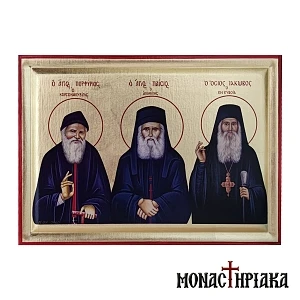
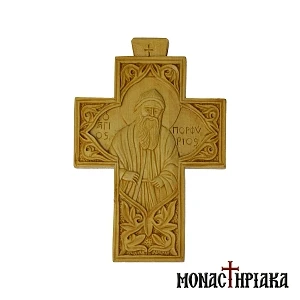
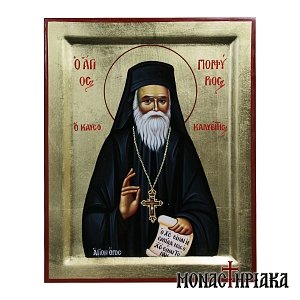
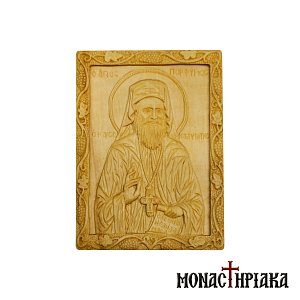
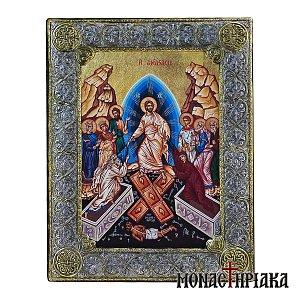
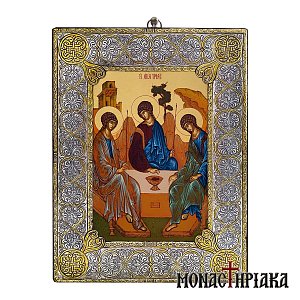
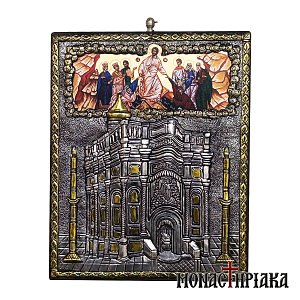
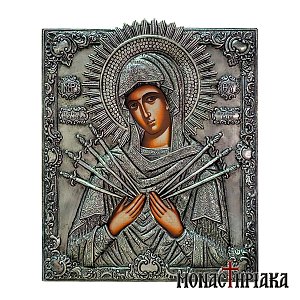
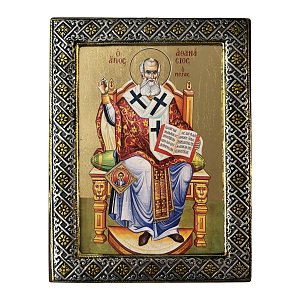
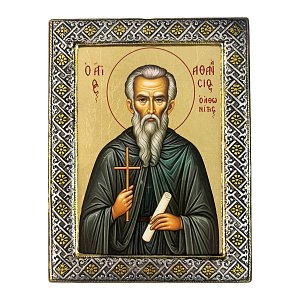
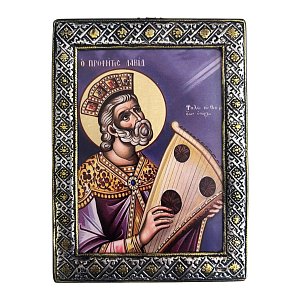
Silver icon with Saint Porphyrios. Handmade silver icon on natural wood, made with 925ο silver with local 22K gold plating. The natural wood used for the synthesis of the icon is beech (fagus) from Mount Athos, a wood that is receptive to aging techniques that give the appearance of vintage to the wood, without altering the depicted image.
The depictions of faces, hands, halos or other representations are depicted in excellent quality and clarity silkscreen with "vivid" colors. The silver frame of the icon is held by nails to resemble the original icons. On the back side, the icon has a small metal ring made of horseshoe nails so that it can be hung.
A Brief Life of Saint Porphyrios the Kausokalivite
Saint Porphyrios from Kavsokalyvia, born Evangelos Bairaktaris in 1906 in Evia, came from a poor but deeply devout family. His parents were faithful Christians, while his father had emigrated to America in order to work and support the family. He grew up in poverty and was forced from an early age to work in order to help his household. He did not receive extensive formal education and experienced a difficult childhood, working in various places across villages and towns. At around the age of twelve, he secretly left his home and went to Mount Athos, driven by his desire to live the ascetic life he deeply admired. There he entered a monastery and, with obedience and love, served under two strict elders. At the age of fourteen, he became a monk, receiving the name Nikitas.
At nineteen, he fell seriously ill and was forced to leave Mount Athos and return to Evia. He lived in several monasteries there and was soon ordained a priest, receiving the name Porphyrios. From that time, he began his ministry as a spiritual father and confessor, helping countless people. Later, he settled in Athens, at the Polyclinic, where for many years he stood beside the sick and those who were suffering. In his later years, he lived in various places of prayer, eventually settling in Mileesi, where he began the construction of a monastery despite his serious health problems. The final years of his life were marked by illness and suffering, yet he desired to return to Mount Athos, where his monastic journey had begun. He eventually reposed there in 1991, in prayer and peace. The Orthodox Church officially canonized him in 2013, and he is commemorated each year on 2 December.