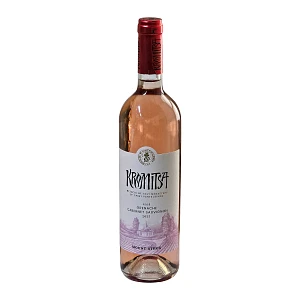
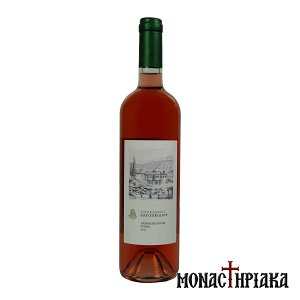
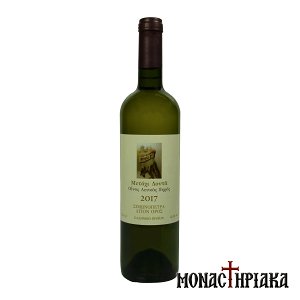
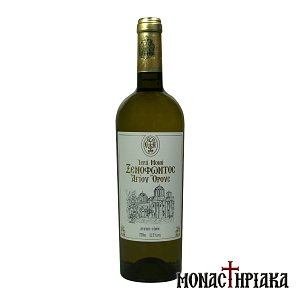
Kromitsa is located in the northern part of Mount Athos and functions as a dependency-glebe (metochi) of the Holy Monastery of St. Panteleimon. The landscape is marked by striking contrasts, where rolling hills, forested areas and cultivated land coexist in a balanced natural setting of exceptional beauty.
For many years, the estate has been closely linked to the life of the Monastery, serving as an important agricultural hub that supports its daily needs and ongoing monastic activity.
KROMITSA Vineyard, Mount Athos
Organic Cultivation for Kromitsa Wines
The Kromitsa vineyard is situated in a unique area in the northern part of Mount Athos, where nature plays a decisive role in vine cultivation. The estate lies within the Natura 2000 network and is distinguished by its rich natural environment, which strongly supports organic farming practices.
Most of the vineyards enjoy views over the Singitic Gulf and Ammouliani Island, while others face the Strymonic Gulf. These varying exposures create different microclimates, giving the grapes their own distinct character and contributing to the uniqueness of Kromitsa wines.
The vineyard is planted with both indigenous and international varieties, including Assyrtiko, Malagousia, Roditis, Chardonnay, Cabernet Sauvignon, Grenache and Limnio. Many of the vines are over 35 years old, continuing a viticultural tradition that has remained alive for decades.
In recent years, a new winery has been established within the estate, allowing the grapes to be vinified on site in the best possible way. Above all, the aim remains the continuation of the winemaking tradition of Kromitsa, with deep respect for both nature and the heritage of the land.
KROMITSA Amphora Chardonnay 2025
Category: PGI Mount Athos
Grape Variety & Winemaking
Chardonnay, a classic international variety that here expresses a more distinctive and refined character, shaped by the unique conditions of the Mount Athos vineyard. Vinification begins in stainless steel tanks and is completed with aging in large clay amphorae, a traditional approach that enhances the wine’s depth, texture and individuality.
Aromatic Profile
The first impression reveals expressive fruity and slightly exotic aromas. As the wine opens in the glass, it develops greater complexity, with mineral and herbal notes such as green tea and savory, along with delicate floral nuances.
Taste Profile & Food Pairing
On the palate it is full-bodied and rich, pleasant texture and finesse. It pairs beautifully with fish, seafood, fresh salads, white meats, oven-baked dishes and mild white cheese.
Historical Background
The history of viticulture in Kromitsa is part of the broader, centuries-old tradition of Mount Athos, where wine has always played a central role in monastic life. For a more detailed view of the development of Athonite winemaking from the 10th century to the present day, dedicated historical studies trace this long and continuous journey.
Antiquity: In the wider region, references are made to the production of the so-called “Acanthus Wine” indicating an early and established winemaking tradition in the area.
10th century (972 AD): The First Typikon and the Golden Bull issued during the time of John Tzimiskes include regulations concerning the production, use and management of Athonite wine.
11th century: Alongside the development of the earliest monastic settlements in the area, the first references to vineyard cultivation in Kromitsa begin to appear.
Early 20th century: Wine production reaches significant levels, with documented large-scale output and well-organised monastic activity.
1970s–1980s: A period of decline, followed by gradual efforts to revive the vineyard, aimed at preserving local tradition and strengthening production. This phase is also linked to the broader recognition of Athonite wine as a protected product.
Modern era: The Holy Monastery of St. Panteleimon takes renewed responsibility for Kromitsa, proceeding with the restoration of the vineyard and the establishment of modern winemaking facilities within the estate.
The spiritual significance of wine in Christian tradition, from the Old to the New Testament, is also highlighted in theological references, where wine is associated with offering and the Holy Eucharist.